
When sourcing sodium hyaluronate, molecular weight is often one of the first parameters buyers consider. However, “higher molecular weight is always better” is not a reliable selection principle. The real question is what your finished product requires in terms of viscosity, dissolution behavior, flow properties, surface film formation, and formulation compatibility—and which grade can meet those requirements.
Based on practical application scenarios, this article helps supplement brands, food and beverage formulation teams, cosmetic OEMs, medical product developers, and procurement professionals understand the differences between sodium hyaluronate molecular weight ranges and establish a practical selection process.
1 Molecular Weight Affects Performance, but Does Not Define the Grade on Its Own
The molecular weight of sodium hyaluronate affects solution viscosity, flow properties, dissolution behavior, surface film formation, and the sensory profile of the finished formulation. In general, lower molecular weight grades are easier to use in formulations that require rapid dispersion, lower viscosity, or a specific penetration profile, while higher molecular weight grades typically provide more pronounced viscosity and surface film-forming properties.
Molecular weight is only one part of the selection decision. Food, cosmetic, pharmaceutical, ophthalmic, and injectable grades are different product categories, each with its own intended uses, quality documentation, and validation requirements. The same molecular weight does not mean that one grade can be directly substituted for another.
You can first review the JointSourceBio Sodium Hyaluronate product page to understand the available molecular weight ranges, product grades, and application directions.
2 How Should You Understand Sodium Hyaluronate Molecular Weight Ranges?
The ranges below follow the molecular weight categories shown on the JointSourceBio product page and are suitable for initial project screening and technical discussions. For actual procurement, the applicable grade-specific TDS, COA, molecular weight distribution report, and quality specifications confirmed by both parties should be treated as the controlling documents.
| Molecular Weight Category | Range Shown on the Product Page | Common Selection Direction |
|---|---|---|
| Nano HA | < 800 Da | Ultra-low molecular weight direction, commonly considered for high-performance skincare and specialized formulation development. |
| Hydrolyzed HA | < 3,000 Da | Enzymatically hydrolyzed with controlled molecular weight; suitable for layered moisturization, post-procedure care, and sensitive-skin formulation directions. |
| Small MW HA | < 10,000 Da | Suitable for selected functional skincare, wound-care, and sensitive-skin formulation directions. |
| Low MW HA | 10,000–400,000 Da | Broad application range; the page lists oral joint-health supplements and functional beverages among the intended directions. |
| Medium MW HA | 400,000–1,500,000 Da | Typically considered for cosmetic formulations that require more pronounced moisturization, film formation, or rheological performance. |
| High MW HA | 1,500,000–2,200,000 Da | The page lists joint injections, ophthalmic solutions, and intensive surface moisturization among the intended directions. |
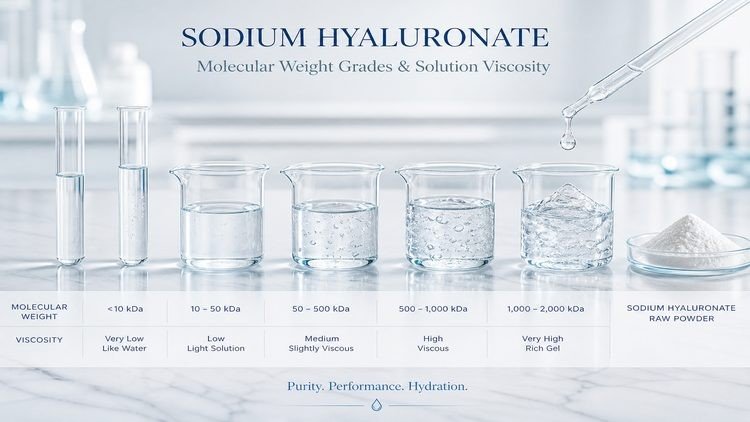
Please note that these categories are product-selection references, not uniform regulatory standards for every market or dosage form. The final choice should also take concentration, dosage form, manufacturing process, target viscosity, and target-market requirements into account.
3 Which Molecular Weight Should You Choose for Different Applications?
Dietary Supplements and Functional Beverages
If your product is a capsule, tablet, powder, or functional beverage, Low MW HA (10,000–400,000 Da) is often a practical range to evaluate first. This range is listed as suitable for oral joint-health supplements and functional beverages. Review the food-grade sodium hyaluronate page for a related product direction.
This does not mean that every oral product must use a low molecular weight grade. You should also confirm whether the powder blends easily, disperses effectively in liquid, provides the required formulation viscosity, and performs well on your actual production equipment. For tablets and capsules, particle size, flowability, blend uniformity, and the filling or compression process should also be evaluated.
Cosmetics and Personal Care Products
Cosmetic formulations are usually not designed around a single molecular weight alone. The choice should reflect the desired moisturization, film formation, sensory profile, and formulation architecture. Nano, Hydrolyzed, Small MW, and Low MW grades can support different formulation directions, while Medium MW and High MW grades are generally more suitable when noticeable surface moisturization, viscosity, or film-forming performance is required.
If the formulation requires multi-level moisturization, you may consider combining sodium hyaluronate grades with different molecular weights. However, the blend ratio, order of dissolution, preservation system, and final sensory profile must be confirmed through sample testing. The final result should not be inferred from molecular weight ranges alone.
Ophthalmic, Injectable, and Medical Product Development
For ophthalmic products, joint injections, aesthetic medical products, and other parenteral products, molecular weight should be evaluated together with intrinsic viscosity, concentration, solution clarity, filtration strategy, packaging, and finished-product validation. The product page lists High MW HA (1,500,000–2,200,000 Da) for applications such as joint injections and ophthalmic solutions, but this is a supplier product classification and cannot replace the customer’s own finished-product development and regulatory validation. See the injectable-grade sodium hyaluronate page for a related product direction.
For these projects, it is better not to tell a supplier only that you need a “high molecular weight” material. A more effective inquiry should also specify the end use, target concentration, target viscosity, product form, filtration or sterilization approach, and target market.

4 Evaluate Molecular Weight and Product Grade Separately
Many sourcing mistakes result from treating “molecular weight” and “grade” as the same thing. Molecular weight primarily describes the size of the polymer molecules and the resulting formulation performance, while product grade covers the raw material’s intended uses, quality-control parameters, documentation system, and manufacturing requirements.
| Evaluation Dimension | Question to Answer | What to Confirm During Procurement |
|---|---|---|
| Molecular weight | What viscosity, flow properties, or film-forming performance does the product require? | Molecular weight range, molecular weight distribution, intrinsic viscosity, and batch-to-batch consistency. |
| Product grade | Will the raw material be used in food, cosmetics, pharmaceutical, ophthalmic, or injectable products? | The relevant grade-specific TDS, COA, SDS, test reports, and applicable documentation. |
| Process compatibility | Can the raw material be used consistently in your process? | Dissolution time, temperature, shear, filtration, packaging, and storage conditions. |
| Finished-product compliance | Can the raw material documentation support your target market and finished product? | Product classification in the target market, the customer’s own validation, and regulatory documentation requirements. |
5 A Five-Step Method for Selecting Sodium Hyaluronate Molecular Weight
Step 1: Define the Finished Product and Use Scenario First
First determine whether the product is a dietary supplement, functional beverage, cosmetic, ophthalmic product, joint injection, or another medical application. Do not start with “high molecular weight” or “low molecular weight” and then try to work backward to the application.
Step 2: Define the Formulation Performance You Need
For example, do you need low viscosity and easy dispersion, or more pronounced viscosity and film-forming performance? Does the powder need to blend easily, or must the solution provide stable rheological behavior? Defining these targets clearly enables the supplier to recommend a suitable range.
Step 3: Confirm the Dosage Form and Manufacturing Process
The same molecular weight may perform differently in powders, capsules, beverages, serums, gels, and injectable products. At a minimum, provide the dosage form, target concentration, processing temperature, mixing method, and filtration requirements.
Step 4: Confirm the Product Grade and Documentation
Once the molecular weight has been shortlisted, confirm whether the material should be food, cosmetic, pharmaceutical, ophthalmic, or injectable grade. Do not rely only on the grade name shown on a webpage. Request the relevant TDS, COA, SDS, molecular weight distribution report, and project-specific test documentation from the supplier.
Step 5: Validate with Samples Instead of Relying on Specifications Alone
Sample testing should simulate actual production conditions as closely as possible. Evaluate dissolution time, clarity, viscosity, blend uniformity, filtration performance, and storage stability. Once the sample meets your requirements, confirm the specifications and batch-to-batch consistency of the commercial material.
6 What Information Should You Request When Contacting a Supplier?
A clear technical inquiry can reduce back-and-forth communication and prevent a supplier from recommending an unsuitable product based on a single keyword. At a minimum, request the following information:
- The specific molecular weight range and a molecular weight distribution report.
- Intrinsic viscosity or other parameters related to formulation performance.
- A batch-specific COA, TDS, and SDS/MSDS.
- Test reports for heavy metals, microbiological limits, endotoxins, and other parameters relevant to the intended application.
- Packaging details, storage conditions, shelf life, and requirements after opening.
- An explanation of specification consistency between the sample batch and the intended commercial batch.
- For medical or injectable products, confirmation of the raw material grade, supplied state, and the boundary between supplier documentation and the customer’s own finished-product validation.

7 Frequently Asked Questions
Is higher molecular weight always better for sodium hyaluronate?
No. A higher molecular weight may provide higher viscosity or more pronounced film-forming performance, but it may also make dissolution, filtration, and manufacturing more difficult. The right choice depends on the end use and the target formulation performance.
Must oral supplements always use a low molecular weight grade?
Not necessarily. The JointSourceBio product page lists Low MW HA (10,000–400,000 Da) for oral joint-health supplements and functional beverages, but the final choice still needs to be confirmed based on the dosage form, concentration, solubility, and the customer’s own sample testing.
Can different molecular weights be combined in a cosmetic formulation?
Different molecular weights can be considered as part of a formulation development strategy, but the blend ratio, dissolution order, formulation compatibility, and final sensory profile must be established through practical testing. Different molecular weights do not simply add together to produce a predictable result.
Is choosing a high molecular weight enough for an injectable product?
No. Injectable products also require confirmation of the product grade, endotoxin level, residual protein and nucleic acids, microbiological quality, clarity, filtration or sterilization process, packaging, and finished-product validation. High molecular weight is only one selection factor.
How should I describe my requirements to a supplier?
Provide the application, target market, dosage form, target molecular weight or viscosity, formulation concentration, estimated purchase volume, and required documentation. The more complete the information, the easier it is for the supplier to recommend a grade that truly fits the project.
8 Conclusion: Choose the Molecular Weight That Fits the Project—Not the Highest Number
The value of sodium hyaluronate molecular weight lies in whether it delivers the right solubility, viscosity, flow properties, film formation, and process performance for your product. No single molecular weight is suitable for every product, and no grade can automatically replace another simply because its label appears more advanced.
Starting with the end use, defining the target formulation performance, and then combining that information with the product grade, technical documentation, and sample testing will lead to a more reliable sourcing decision. The JointSourceBio product page offers multiple molecular weight ranges and product grades; during procurement, you can further confirm the appropriate specification according to your application, target market, and technical requirements.
To learn more about the complete product range, visit Sodium Hyaluronate Manufacturer & Bulk Supplier, or contact JointSourceBio with your application, target molecular weight/viscosity, dosage form, and estimated volume.